

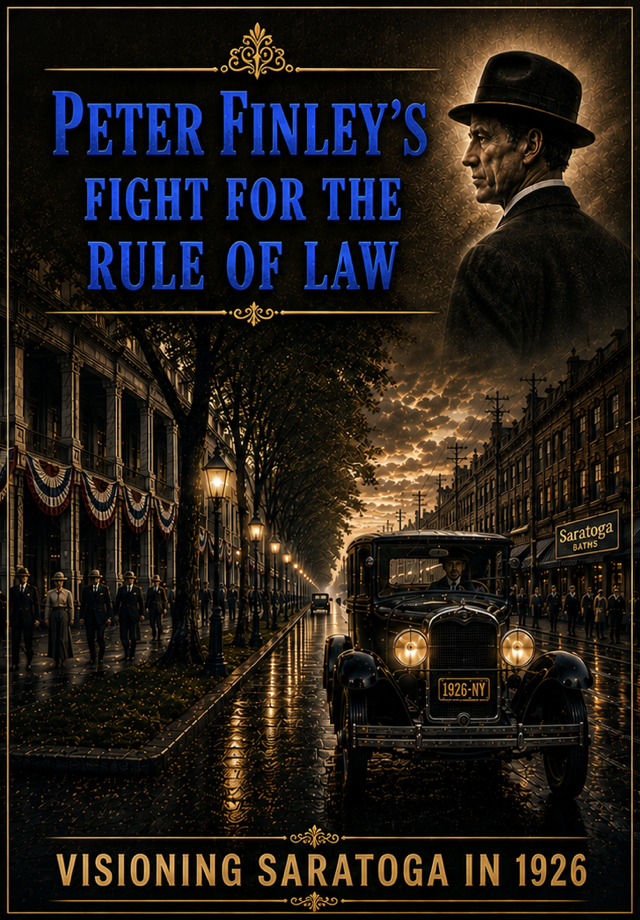
In the summer of 1926, Saratoga Springs stood at the height of its fame — and perhaps at the height of its contradictions.
Saratoga Springs was America’s most celebrated summer resort. Railroad magnates, Wall Street financiers, politicians, bookmakers, actresses, sportsmen, and socialites crowded Broadway beneath the elms. The verandas of the Grand Union and United States Hotel glittered with jewelry and linen suits. Packards and Pierce Arrows rolled down Broadway. Some wealthy visitors landed in amphibious aircraft on fields outside town
But beneath Saratoga’s elegant surface lay a parallel city — a world of gambling rooms, political accommodations, protected vice, speakeasies, and quiet understandings between criminals and public officials.
By 1926, many residents had come to believe that the machinery of government itself had become entangled with Saratoga’s gambling economy. That summer, the city’s long-running balancing act between glamour and lawlessness began to collapse.
At the center of the growing storm stood a quiet but determined reformer named Peter A. Finley, a respected local attorney, businessman, and president of the Saratoga Taxpayers Association — a civic organization increasingly alarmed by the city’s deteriorating reputation and the apparent inability, or unwillingness, of officials to enforce the law impartially.
On July 23, 1926, Finley took the extraordinary step of writing directly to New York Governor Al Smith. His complaint was blunt, carefully documented, and explosive in its implications. Saratoga Springs, he argued, had fallen under the influence of organized gambling interests operating with political protection. Local authorities, he charged, could no longer be trusted to police themselves.
Finley’s open letter to the Governor triggered one of the most dramatic public investigations in Saratoga Springs history — a confrontation that exposed the hidden machinery beneath the city’s glittering façade. Nearly a century later, we return to that summer to understand how Saratoga arrived at its moment of reckoning, and what the struggle between power, vice, and civic conscience still reveals about the city today.
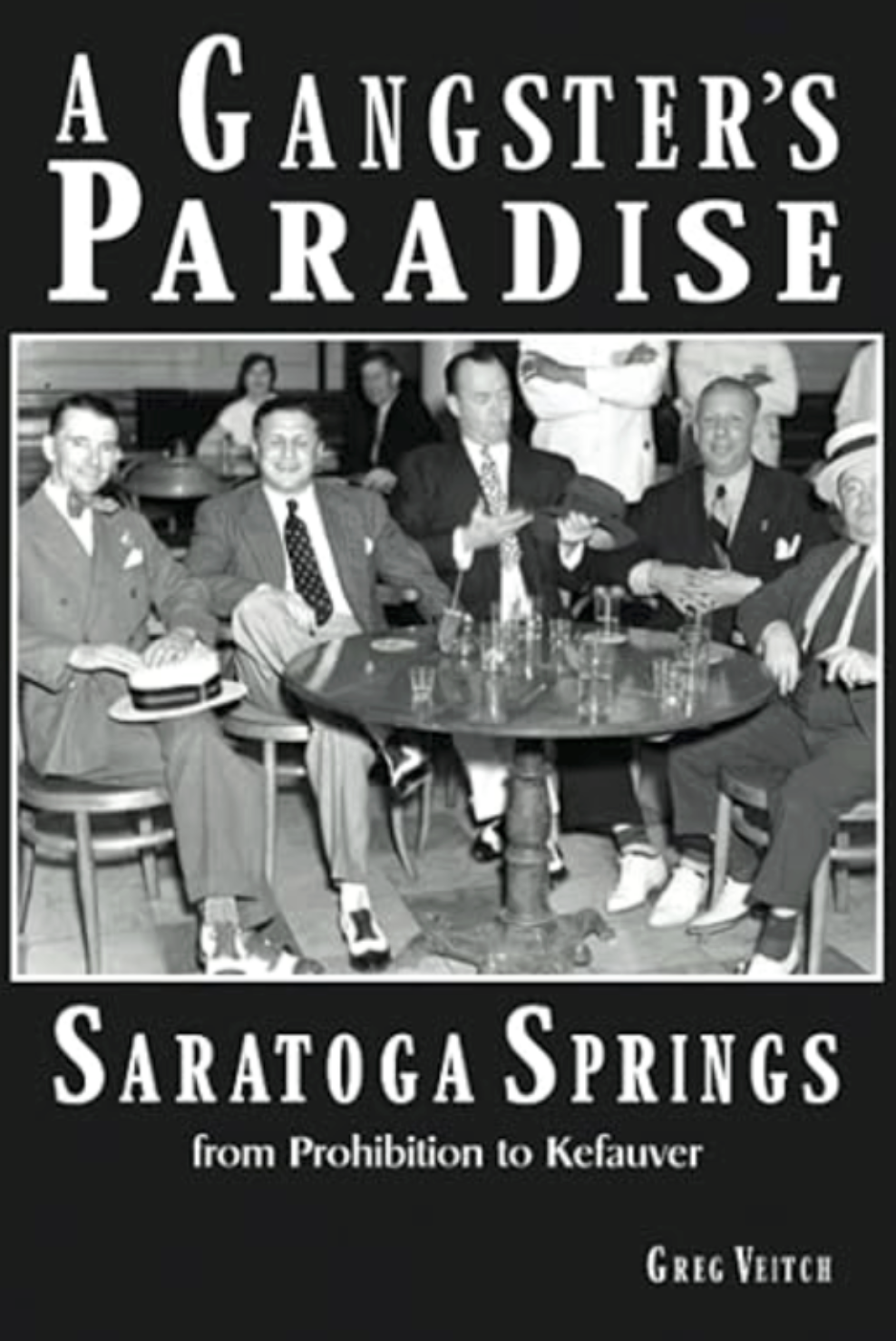
Greg Veitch compactly chronicles the events of the summer of 1926 in Chapter 3 of A Gangster’s Paradise: Saratoga Springs from Prohibition to Kefauver.
These 28 pages read like the Saratoga equivalent of Boardwalk Empire.By gathering details and perspectives from Greg and other additional historians, a group of us are exploring our ability to produce such a work with help from Artificial Intelligence.
NotebookLM is a source-grounded research tool that allows us to assemble up to 200 documents — books, hearing transcripts, newspaper reports, photographs, timelines, and interviews — in a single organized knowledge base that AI can analyze, compare, summarize, and synthesize. Because the system is constrained to the materials we upload, it dramatically reduces the “hallucinations” often associated with generative AI and instead functions more like an extraordinarily fast research assistant with total recall.

It was NotebookLM that, in its dissection of A Gangster’s Paradise, informed us that a compelling 100th anniversary is approaching on July 23rd and thereby triggered this collaborative telling of Peter Finley’s story. In coming weeks, we’ll be inviting more historians to share their knowledge of organized crime in Saratoga Springs in the first quarter of the 20th century. Many thanks to Carol Godette, for instance, for adding to our NotebookLM workspace this in-depth profile of Caleb Mitchell, whose suicide in Town Hall in 1902 provides a dramatic opening to the drafts we’re developing in the three versions you’ll find below.
We find a few details in these drafts that NotebookLM has not gotten exactly right, but we’ll let them stand as clearly marked drafts we do further research. July 23rd is our deadline for a complete corrected narrative, to be share installments through late July, August and September, leading up to the Saratoga Book Festival the weekend of October 2-4.